
Differential Equations and Linear Algebra: A Comprehensive Guide
Exploring the synergy between differential equations and linear algebra, this guide delves into essential concepts, offering a robust foundation for engineering and physics applications.

Differential equations and linear algebra, seemingly disparate mathematical disciplines, are profoundly interconnected, forming the bedrock of numerous scientific and engineering applications. This synergy arises because linear algebra provides the tools to analyze and solve many differential equations, particularly systems of equations. The study of these intertwined fields often begins with foundational concepts in both areas – understanding rates of change (differential equations) and the properties of vector spaces and matrices (linear algebra).
Resources like the “Differential Equations and Linear Algebra” textbook, in its various editions, demonstrate this integrated approach. These texts often cover first-order equations, systems of linear equations, determinants, and vector spaces early on, establishing a framework for more advanced topics. The combination allows for a powerful methodology in modeling and solving complex problems across diverse disciplines.
The Importance of Linear Algebra in Solving Differential Equations
Linear algebra is indispensable for solving differential equations, particularly when dealing with systems. Representing differential equations as matrix equations transforms complex problems into manageable linear algebraic forms. Techniques like eigenvalue and eigenvector analysis, central to linear algebra, unlock solutions to homogeneous systems, revealing fundamental behaviors;
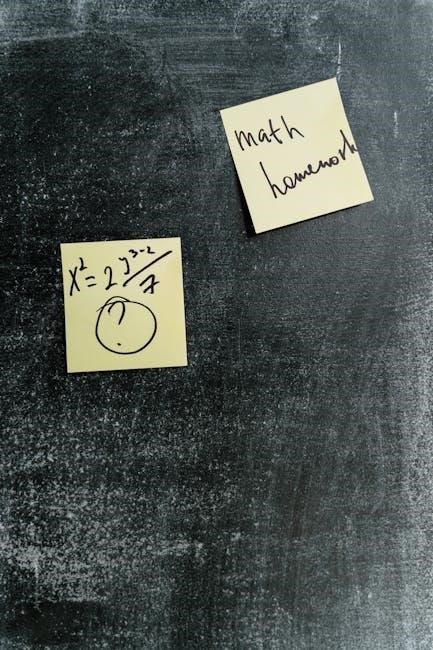
The ability to express systems of differential equations – representing intersections of planes, as noted in resources – as Ax = b, highlights this connection. Furthermore, the Laplace transform, a powerful tool, relies heavily on linear algebraic concepts for its application and interpretation. Understanding linear algebra arithmetic, as emphasized in lecture notes, is crucial for effectively utilizing these methods and achieving accurate solutions.
Core Concepts in Differential Equations
Differential equations model dynamic systems, describing relationships between functions and their derivatives. First-order equations, foundational to the field, explore rates of change, while higher-order (order n) equations delve into more complex interactions. Series solutions provide methods for approximating solutions when analytical forms are elusive, particularly useful for non-linear scenarios.

A comprehensive understanding necessitates mastering these core concepts, as outlined in textbooks like “Differential Equations and Linear Algebra”. The study progresses from simpler first and second-order equations, often coupled with the Laplace transform, before integrating linear algebra. This structured approach, evident in course materials, builds a strong base for tackling advanced problems and real-world applications.
First-Order Differential Equations
First-order differential equations, involving only the first derivative of the unknown function, represent fundamental building blocks in modeling various phenomena. These equations often describe rates of change and are solvable using techniques like separation of variables, integrating factors, and linear equations methods.
As detailed in resources like “Differential Equations and Linear Algebra”, Chapter 1 often dedicates significant attention to these equations. Understanding their behavior is crucial, as they frequently appear as components within more complex systems. The ability to analyze and solve these equations forms a cornerstone for tackling higher-order equations and systems, providing a solid foundation for advanced mathematical modeling.
Linear Differential Equations of Order n
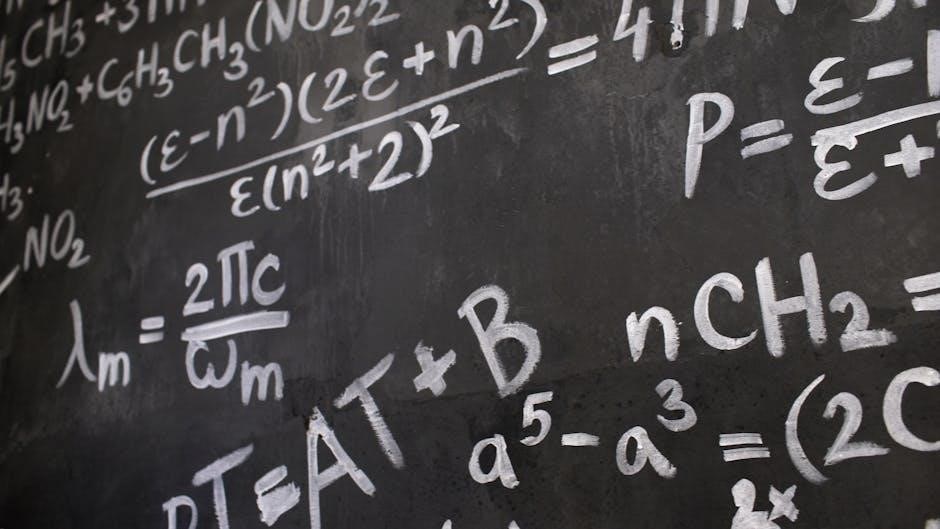
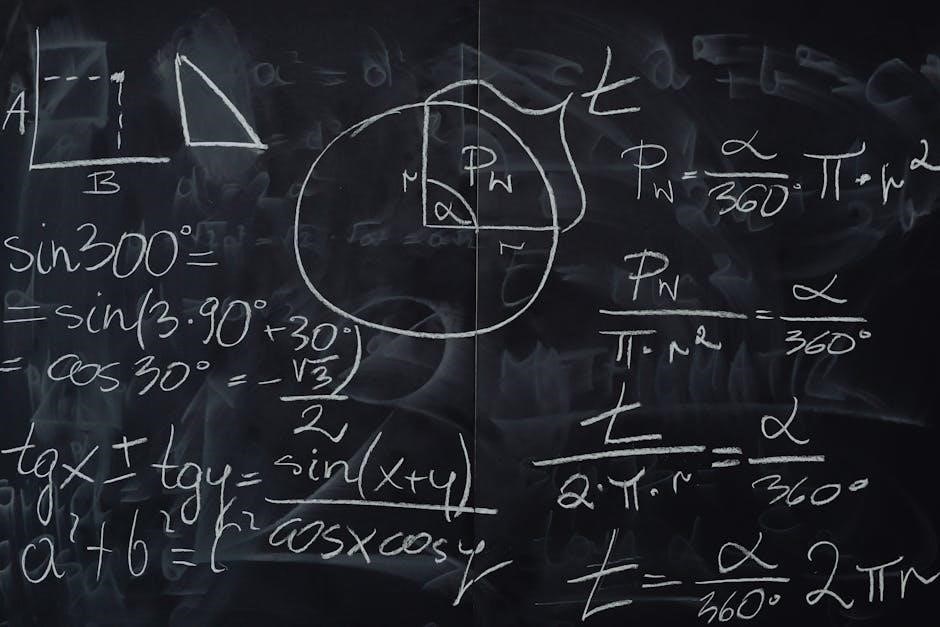
Linear differential equations of order n extend the concepts of first-order equations, incorporating derivatives up to the nth order. These equations are characterized by linearity – the sum of solutions is also a solution – and are central to modeling diverse physical systems, from mechanical vibrations to electrical circuits.
Resources like the referenced textbook dedicate Chapter 6 to these equations, emphasizing techniques like finding homogeneous solutions and particular solutions using methods like undetermined coefficients or variation of parameters. Understanding the interplay between the equation’s coefficients and the resulting solutions is key. Linear algebra plays a vital role in representing and solving these equations, particularly when dealing with systems of such equations.
Series Solutions to Linear Differential Equations
When elementary methods fail, series solutions provide a powerful approach to solving linear differential equations, particularly those with variable coefficients. This technique involves expressing the solution as an infinite series, often a power series, and determining the coefficients by substituting the series into the differential equation.
Chapter 9 in the referenced text focuses on this method, detailing how to find recurrence relations for the series coefficients and establish the radius of convergence. The method is particularly useful when closed-form solutions are unavailable; Linear algebra concepts, such as matrix representation of recurrence relations, can aid in analyzing the series and determining its properties, offering a robust analytical tool.
Fundamental Principles of Linear Algebra

Linear algebra forms the bedrock for understanding and solving differential equations, providing tools to analyze systems and uncover solutions. Core concepts include matrices, representing linear transformations and systems of equations, as detailed in Chapter 2 of the referenced material. Determinants, explored in Chapter 3, offer insights into matrix properties and solvability.
Furthermore, vector spaces, foundational to the field (Chapter 4), provide an abstract framework for representing functions and solutions. Understanding these principles is crucial, as they enable the manipulation and analysis of complex systems encountered in differential equations, offering a powerful analytical approach.
Matrices and Systems of Linear Equations
Matrices provide a concise and powerful notation for representing systems of linear equations, a cornerstone of both linear algebra and differential equations. As highlighted in Chapter 2 of the referenced text, a system of equations can be visualized as intersecting lines in a plane or planes in 3D space, with solutions representing these intersections.
The representation Ax = b defines a system; if b is the zero vector, it’s a homogeneous system. Mastering matrix operations – addition, multiplication, and inversion – is vital for solving these systems efficiently. These techniques are fundamental for analyzing the behavior of linear systems arising from differential equation problems.
Determinants and Their Applications
Determinants, explored in Chapter 3, are scalar values computed from square matrices, revealing crucial information about the matrix and its corresponding system of linear equations. A non-zero determinant signifies an invertible matrix, meaning a unique solution exists for the associated system Ax = b.
Determinants are instrumental in assessing the stability of solutions in differential equations and understanding the qualitative behavior of linear systems. They help determine if solutions are unique, infinite, or nonexistent. Furthermore, determinants play a role in calculating eigenvalues, essential for analyzing the long-term behavior of differential equation solutions, particularly in systems.
Vector Spaces: Foundations and Properties
Chapter 4 introduces vector spaces, the fundamental building blocks for understanding linear algebra and its application to differential equations. A vector space comprises a set of objects (vectors) and operations satisfying specific axioms, enabling consistent mathematical manipulation.
These spaces provide a framework for representing solutions to homogeneous linear differential equations. The set of all possible solutions forms a vector space, allowing us to leverage linear algebra tools for analysis. Concepts like linear independence, basis, and dimension are crucial for characterizing solution spaces and understanding their properties. Understanding vector spaces is vital for solving systems of equations and analyzing linear transformations.
Linear Transformations and Their Role
Linear transformations are functions between vector spaces that preserve vector addition and scalar multiplication, playing a pivotal role in connecting linear algebra to differential equations. They provide a powerful way to analyze how solutions to differential equations change under different conditions.
Representing differential operators as linear transformations allows us to apply matrix representations and eigenvalue analysis. This approach simplifies the process of finding solutions and understanding their behavior. Furthermore, linear transformations are essential for understanding the fundamental properties of systems of differential equations, including stability and sensitivity to initial conditions. They offer a structured approach to solving complex problems.
Homogeneous vs. Non-Homogeneous Systems
Distinguishing between homogeneous and non-homogeneous systems is crucial in both linear algebra and differential equations, impacting solution methods and interpretations. A homogeneous system, represented as Ax = 0, always possesses the trivial solution (x = 0), alongside potentially infinite non-trivial solutions depending on the rank of matrix A.
Conversely, a non-homogeneous system, Ax = b (where b ≠ 0), may have no solution, a unique solution, or infinite solutions. Understanding this distinction is vital when solving differential equations, as the general solution comprises the homogeneous solution plus a particular solution for the non-homogeneous part. This separation simplifies complex problem-solving.
The Laplace Transform: A Powerful Tool
The Laplace transform provides a potent method for solving linear differential equations, converting them into algebraic equations in the frequency domain. This transformation simplifies the process, particularly for equations with initial conditions, offering a streamlined approach to finding solutions. It’s especially effective for systems involving forcing functions and transient responses.
By applying the Laplace transform, differentiation becomes multiplication, and integration becomes division, drastically reducing the complexity of the original differential equation. The inverse Laplace transform then recovers the solution in the time domain. Chapters dedicated to this technique often precede explorations of systems of differential equations, building a strong analytical foundation.
Elementary Applications of the Laplace Transform
The Laplace transform excels in solving initial value problems, particularly those involving common forcing functions like step functions and sinusoidal inputs. Its elementary applications include circuit analysis, where it simplifies the determination of currents and voltages in response to applied sources. Mechanical systems, such as damped harmonic oscillators, also benefit from this technique, allowing for easy calculation of displacement and velocity.

Furthermore, the Laplace transform aids in analyzing control systems, providing insights into stability and response characteristics. Textbooks often demonstrate these applications with practical examples, solidifying understanding. The transform’s ability to handle discontinuous functions makes it invaluable for modeling real-world phenomena.
Systems of Differential Equations: An Overview
Many real-world phenomena are best modeled by systems of differential equations, rather than single equations. These systems describe the interconnected rates of change of multiple variables. Linear systems, particularly, benefit from the tools of linear algebra for analysis and solution. Representing these systems in matrix form allows for efficient computation of eigenvalues and eigenvectors, crucial for understanding system behavior.
Solutions often involve finding fundamental matrices and applying techniques like variation of parameters. Understanding the stability of these systems – whether solutions converge or diverge – is paramount in applications like population dynamics and chemical reactions. Resources like “Differential Equations with Linear Algebra” provide detailed explorations of these concepts.
Connecting Linear Algebra and Differential Equations
The profound connection between linear algebra and differential equations lies in representing differential equations as matrix equations. This transformation allows us to leverage the power of linear algebra techniques for solving these equations. Systems like Ax = b, where x represents the unknown functions, become central to the analysis.
Eigenvalues and eigenvectors play a critical role in finding solutions, particularly for homogeneous systems. They reveal fundamental modes of behavior and determine the system’s stability. Textbooks like those referenced – including editions from 2011 and 2025 – emphasize this interplay, demonstrating how linear algebra provides a framework for understanding and solving complex differential equation problems.
Using Matrices to Represent Differential Equations
Transforming differential equations into matrix form is a cornerstone of their solution. Higher-order linear differential equations can be expressed as a system of first-order equations, subsequently represented by a matrix equation. This allows application of powerful linear algebra tools, such as finding determinants and inverses, to analyze the system’s behavior.

As highlighted in resources from 2011 and 2025, this matrix representation simplifies the process of finding solutions, especially for systems with multiple variables. The coefficients of the derivatives form the matrix, enabling a compact and efficient method for solving complex problems. Understanding this conversion is crucial for applying linear algebra techniques effectively.
Eigenvalues and Eigenvectors in Differential Equation Solutions
Eigenvalues and eigenvectors play a pivotal role in determining the long-term behavior of solutions to systems of differential equations. When a matrix representing a system of differential equations is diagonalizable, its eigenvectors form a basis for the solution space. The corresponding eigenvalues dictate the rate of growth or decay of the solutions.
Resources from 2011 emphasize that understanding these concepts is vital for analyzing stability and predicting system responses. By finding eigenvalues, we can classify equilibrium points and determine whether they are stable or unstable. This connection between linear algebra and differential equations provides a powerful framework for solving and interpreting dynamic systems.
Applications in Engineering and Physics
Differential equations and linear algebra are foundational tools across numerous engineering and physics disciplines. In electrical engineering, they model circuit behavior and signal processing. Mechanical engineers utilize them for analyzing vibrations, structural mechanics, and fluid dynamics. Physics relies heavily on these concepts for quantum mechanics, electromagnetism, and thermodynamics.
The combined power of these fields allows for the creation of accurate models and simulations. Resources highlight the integration of these topics in engineering curricula, reflecting their practical importance. Understanding these principles enables engineers and physicists to solve complex problems and design innovative solutions, driving advancements in technology and scientific understanding.
Resources for Further Study
Numerous resources exist to deepen your understanding of differential equations and linear algebra. Recommended textbooks include “Differential Equations and Linear Algebra”, 3rd Edition, offering a comprehensive approach. Online platforms provide accessible learning materials, such as MIT OpenCourseWare and Khan Academy, featuring video lectures and practice problems.
Several PDF resources, like those found on DOKUMEN.PUB, offer table of contents and chapter previews from various editions. Ben Woodruff’s notes provide a focused perspective on the interplay between these fields. Exploring these materials will solidify your grasp of core concepts and enhance your problem-solving abilities, preparing you for advanced study and real-world applications.
Recommended Textbooks (e.g., “Differential Equations and Linear Algebra”, 3rd Edition)
For a structured learning experience, several textbooks are highly recommended. “Differential Equations and Linear Algebra”, 3rd Edition, provides a thorough exploration of both subjects, ideal for a comprehensive understanding. Exploring PDFs of tables of contents, as available on DOKUMEN.PUB, can help assess a book’s suitability.
Other valuable resources include texts focusing on applied linear algebra and differential equations, often tailored for engineering students. Ben Woodruff’s materials offer a unique perspective. Consider editions with accompanying solution manuals for practice. These resources, combined with online materials, will build a strong foundation in these interconnected mathematical disciplines, preparing you for advanced coursework and practical applications.
Online Courses and Tutorials
Supplementing textbook study with online resources is crucial for mastering differential equations and linear algebra. Platforms like Coursera, edX, and Khan Academy offer structured courses, often featuring video lectures and practice problems. Searching for “differential equations and linear algebra pdf” can uncover supplementary materials, lecture notes, and solved examples.
YouTube provides a wealth of tutorials covering specific topics, allowing for focused learning. Websites dedicated to mathematics, such as Paul’s Online Math Notes, offer detailed explanations and practice exercises. Remember to critically evaluate the source and ensure the content aligns with your course material. Combining these resources will enhance your understanding and problem-solving skills.
Future Trends and Research Directions
The intersection of differential equations and linear algebra continues to evolve, driven by computational advancements and real-world applications. Current research focuses on developing efficient numerical methods for solving complex systems, leveraging high-performance computing and machine learning techniques. Exploring fractional differential equations and their applications in modeling anomalous diffusion is a growing area.
Furthermore, research delves into the analysis of large-scale systems, utilizing spectral methods and model reduction techniques. Accessing resources labeled “differential equations and linear algebra pdf” can reveal cutting-edge research papers and preprints. The development of robust algorithms for parameter estimation and uncertainty quantification remains a key challenge, impacting fields like control theory and data science.