
The Elektron Digitone is a powerful digital synthesizer, detailed in its comprehensive manual. It expertly blends FM synthesis with diverse digital methods, offering extensive sound design.
Digitone Overview
The Elektron Digitone represents a significant leap in digital synthesis, meticulously documented within its user manual. This instrument isn’t simply a synthesizer; it’s a complete sound design environment, offering a unique blend of immediacy and depth. The manual clearly outlines its core functionality, detailing how the Digitone combines Frequency Modulation (FM) synthesis with multiple other digital synthesis techniques.
It’s described as a “multi-machine” instrument, meaning it houses various synthesis engines, each providing distinct sonic characteristics. The manual guides users through understanding these machines and how to leverage their individual strengths. Beyond synthesis, the Digitone boasts a robust sequencer, allowing for intricate pattern creation and performance. The manual dedicates substantial sections to sequencing basics, step input, and pattern structuring.
Whether you’re a seasoned synthesist or a newcomer, the Digitone’s manual serves as an essential companion, unlocking the full potential of this versatile instrument. It’s available for free online, catering to both Digitone and Digitone Keys models.
Key Features & Capabilities
According to the Digitone manual, its core strength lies in its multi-machine architecture, offering a diverse palette of synthesis options. Users can switch between different “machines” – essentially, distinct synthesis engines – to sculpt a wide range of sounds, from melodic tones to aggressive percussive elements. The manual thoroughly explains each machine’s parameters and characteristics.
The Digitone’s sequencer is another key feature, enabling complex pattern creation and real-time performance control. The manual details step input, editing techniques, and pattern structuring, empowering users to craft intricate rhythmic and melodic sequences. Furthermore, the instrument supports external control via MIDI, expanding its integration possibilities with other gear.
Crucially, the manual highlights the Digitone’s audio input capabilities, allowing users to process external audio sources. This feature, combined with the internal effects, opens up creative possibilities for sampling and sound manipulation. The manual provides clear instructions on connecting audio and utilizing these inputs effectively.
Intended Use & Target Audience
The Elektron Digitone, as detailed in its manual, is designed for musicians, sound designers, and electronic music producers seeking a versatile and powerful synthesis tool. It caters to both beginners exploring FM synthesis and experienced users looking for a sophisticated instrument with deep editing capabilities. The manual’s clear explanations make it accessible to a wide range of skill levels.
Its intended use spans various musical genres, including techno, house, ambient, and experimental electronic music. The Digitone excels at creating both melodic and rhythmic elements, making it suitable for composing full tracks or adding unique textures to existing productions. The manual showcases examples of how to achieve different sonic results.
The instrument’s portability and robust build quality also suggest it’s intended for live performance, alongside studio production. The manual provides guidance on utilizing performance macros and external control for dynamic live sets, appealing to performing musicians.
Getting Started with Digitone
The Digitone manual guides users through unboxing, initial setup, and powering on/off. It details basic operations and helps understand the interface quickly and efficiently.
Unboxing & Initial Setup
Upon receiving your Elektron Digitone, carefully inspect the packaging for any signs of damage during transit. The box should contain the Digitone unit itself, a power adapter, and potentially some documentation including quick start guides and warranty information. Before connecting the power, visually inspect the Digitone for any physical defects.
Initial setup involves connecting the included power adapter to the Digitone and a suitable power outlet. Ensure the voltage matches your region to avoid damage. Once powered on, the Digitone may prompt you to initialize settings or update the operating system. Following the on-screen instructions is crucial for a smooth setup process. The manual emphasizes a complete restart requires waiting at least 30 seconds after powering off before turning it back on.
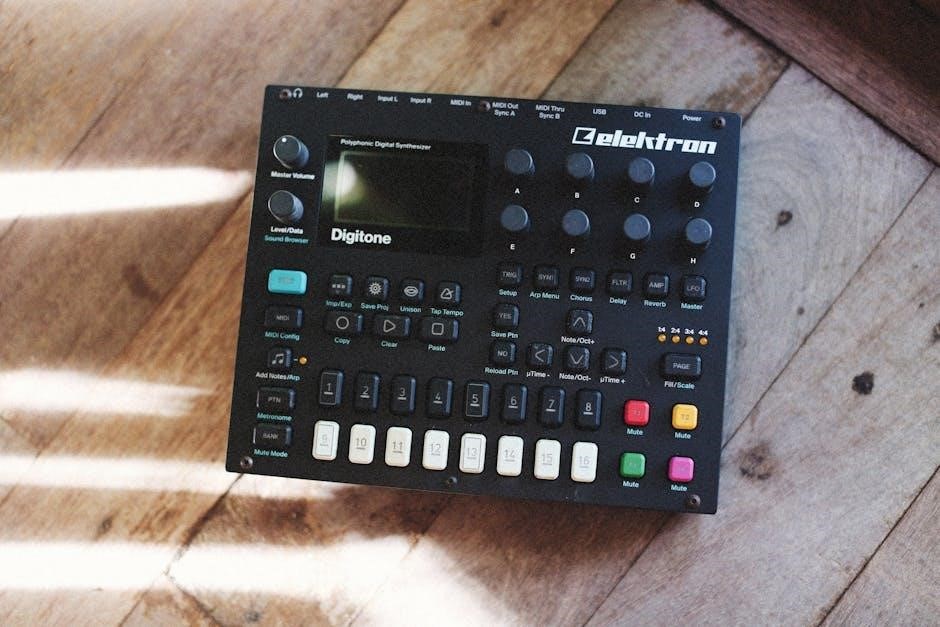
Familiarize yourself with the rear panel connections, including the audio inputs and outputs, MIDI ports, and USB port. The manual provides detailed diagrams and explanations of each connection type. Proper initial setup ensures optimal performance and prevents potential issues down the line.
Powering On/Off & Basic Operations
To power on the Elektron Digitone, locate the power switch, typically found on the rear panel. Pressing this switch initiates the boot-up sequence, displaying the Elektron logo and loading the operating system. The manual stresses the importance of a complete power cycle – waiting a minimum of 30 seconds after switching off before powering on again – to ensure system stability and prevent potential glitches.
Basic operations involve navigating the Digitone’s interface using the knobs, buttons, and screen. The manual details how to access different menus and parameters. Understanding the function of each button is key to efficient workflow. Initial exploration should focus on loading a preset sound and experimenting with the filter and envelope controls.
The Digitone’s responsiveness is immediate, allowing for real-time adjustments. The manual highlights the importance of saving your work frequently to avoid losing progress. Familiarizing yourself with these fundamental operations will unlock the Digitone’s full potential.
Understanding the Digitone Interface
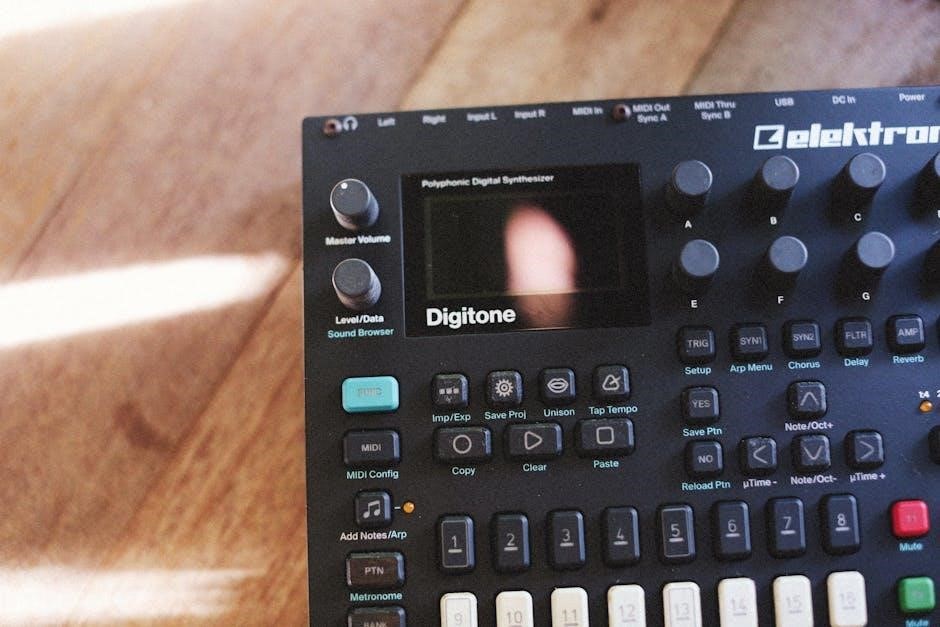
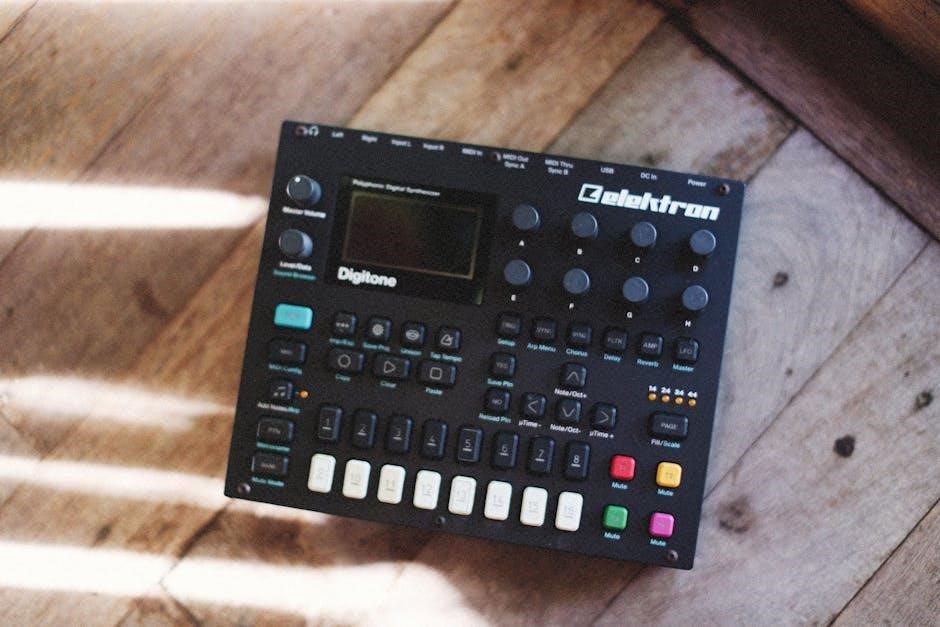
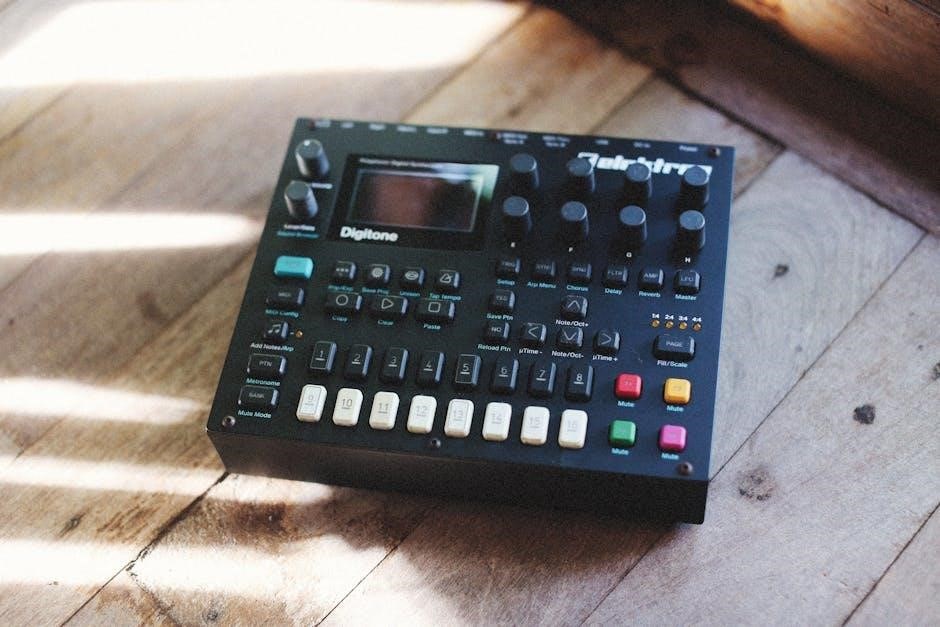
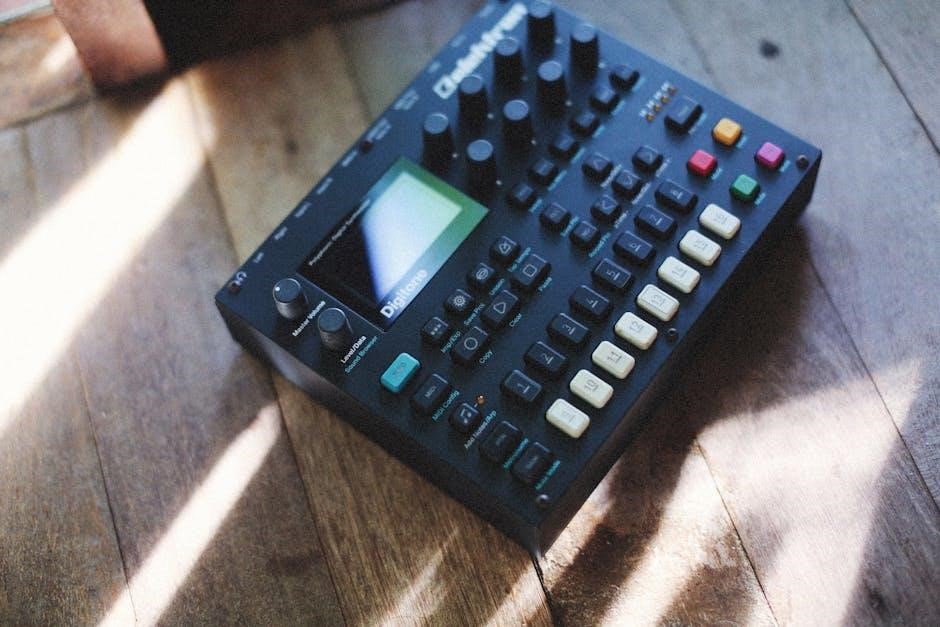
The Elektron Digitone’s interface, as detailed in the manual, centers around a high-contrast display screen and an array of tactile controls. These include four endless rotary encoders, dedicated buttons for key functions, and a responsive four-directional joystick for navigation. The manual emphasizes learning the layout for efficient workflow.
The screen presents a clear overview of the current sound, sequencing data, and menu options. Understanding the different screen modes – such as Track View, Mixer View, and Global View – is crucial. The encoders allow for precise parameter adjustments, while the buttons provide quick access to essential functions like track selection and sound editing.
The manual guides users through the menu system, explaining the organization of parameters and settings. Mastering the interface unlocks the Digitone’s powerful synthesis and sequencing capabilities, enabling deep sound design and expressive performance.

Sound Engine & Synthesis
The Digitone’s sound engine, as explained in the manual, utilizes FM synthesis alongside other digital methods. It’s a multi-machine instrument offering diverse sound-shaping options.
FM Synthesis Fundamentals
The Elektron Digitone’s core lies in Frequency Modulation (FM) synthesis, a technique thoroughly explained within its manual. FM synthesis creates complex tones by modulating the frequency of one oscillator (the carrier) with another (the modulator). This process generates sidebands, resulting in rich harmonic content far beyond simple waveforms.
The manual details how the Digitone’s multi-machine architecture allows for various FM algorithms, impacting the resulting sound. Different algorithms route the modulators and carriers in unique ways, leading to drastically different timbres. Understanding these algorithms is key to unlocking the Digitone’s sonic potential.
Furthermore, the manual clarifies how parameters like modulation index and ratio control the intensity and frequency relationship between the carrier and modulator. These controls are crucial for sculpting the FM sound, ranging from subtle warmth to aggressive, metallic tones. The Digitone’s implementation of FM is designed for both intuitive exploration and precise control, as detailed in the comprehensive documentation.
Multi-Machine Architecture
The Elektron Digitone distinguishes itself with a “multi-machine” architecture, a concept extensively covered in its user manual. This system isn’t simply about multiple oscillators; it’s about fundamentally different synthesis engines housed within a single instrument. Each machine represents a distinct synthesis approach, offering unique sonic characteristics.
The manual explains how users can switch between these machines – including FM, wavetable, and virtual analog – instantly, dramatically altering the sound. This allows for complex layering and hybrid sound design, blending the strengths of each engine. The Digitone isn’t limited to one synthesis style; it embraces diversity.
Crucially, the manual details how parameters interact differently depending on the selected machine. What controls filter cutoff on a virtual analog machine will behave differently on an FM machine. Mastering these nuances is vital for maximizing the Digitone’s expressive range and achieving desired sonic textures, as thoroughly documented within the guide.
Oscillator Configuration
The Elektron Digitone’s oscillator configuration is a core element, deeply explained within its manual. Unlike traditional synthesizers, the Digitone doesn’t simply offer oscillators; it presents “machines,” each with unique oscillator behaviors. The manual details how to select and configure these machines – FM, wavetable, noise, and more – to form the foundation of any sound.
Each machine boasts specific parameters for shaping the oscillator’s output. The FM machine, for example, allows for intricate modulator/carrier relationships, fully documented with visual aids in the manual. Wavetable machines offer waveform selection and morphing capabilities. Understanding these controls is crucial.
The manual also clarifies how to utilize the Digitone’s four tracks, each capable of hosting a different machine and oscillator configuration. This allows for layered sounds and complex textures. Mastering oscillator configuration, as outlined in the guide, unlocks the Digitone’s full sonic potential.
Sequencing & Pattern Creation
The Digitone manual thoroughly covers its sequencer, detailing step input, editing, and pattern structure. It guides users through creating rhythmic and melodic patterns with ease.
Digitone Sequencer Basics
The Elektron Digitone’s sequencer is a core component, and the manual dedicates significant attention to its operation. It’s a powerful tool for crafting intricate and evolving musical ideas. The sequencer operates on a step-based system, where each step represents a moment in time within a pattern. Users can program notes, rests, and parameter changes for each step.
The manual explains how to navigate the sequencer’s various modes, including step input, real-time recording, and parameter locking. Parameter locks allow you to store specific parameter values for individual steps, creating dynamic variations within a pattern. Understanding the concept of tracks is crucial; each track represents a separate instrument or sound within the Digitone.
The manual details how to assign sounds to tracks and how to utilize the sequencer to control multiple tracks simultaneously. It also covers the basics of pattern chaining, allowing you to seamlessly transition between different patterns to create longer and more complex arrangements. Mastering these fundamentals, as outlined in the manual, unlocks the full potential of the Digitone’s sequencing capabilities.
Step Input & Editing
The Digitone manual thoroughly covers step input and editing, essential for pattern creation. Step input allows users to directly program notes and parameters for each step in a sequence. The manual details various input methods, including using the Digitone’s keys, the chromatic mode, and external MIDI controllers. Editing existing steps is equally straightforward, with dedicated functions for adjusting pitch, velocity, length, and other parameters.
The manual explains how to utilize the “copy/paste” functions to quickly duplicate steps or sections of a pattern. It also details the “fill” functions, which can automatically generate variations based on existing steps. Parameter editing is a key focus, with the manual illustrating how to access and modify parameters on a per-step basis using parameter locks.
Furthermore, the manual guides users through advanced editing techniques, such as using the “micro-timing” feature to subtly shift the timing of individual steps, adding a human feel to the sequence. Mastering these techniques, as described in the manual, allows for precise and nuanced control over the Digitone’s patterns.
Pattern Length & Structure
The Digitone manual dedicates significant attention to pattern length and structure, crucial for sequencing. Users can define pattern lengths from 1 to 64 steps, offering flexibility for diverse rhythmic ideas. The manual details how to adjust the pattern length globally or on a per-track basis, enabling polyrhythmic possibilities. It explains the concept of “pattern chaining,” allowing multiple patterns to be linked together for extended compositions.
The manual illustrates how to utilize the “pattern mode” to switch between different patterns during performance or recording. It also covers the use of “jump” conditions, which allow patterns to branch based on specific triggers or conditions. Understanding pattern structure is key to creating complex arrangements, and the manual provides clear explanations of these concepts.
Furthermore, the manual guides users through the use of “fill” patterns, short patterns that can be triggered to add variations and fills to the main sequence. Mastering these features, as detailed in the manual, unlocks the full potential of the Digitone’s sequencing capabilities.
Performance & Control
The Digitone manual thoroughly explains real-time parameter control, performance macros, and external MIDI control. It details how to manipulate sounds dynamically during live sets.
Real-Time Parameter Control
The Elektron Digitone’s manual dedicates significant attention to real-time parameter control, a cornerstone of its expressive capabilities. Users can sculpt sounds on-the-fly, adjusting virtually any parameter while performing or composing. This is achieved through a combination of dedicated encoders, the performance macros, and external MIDI controllers.
The manual details how each encoder corresponds to specific parameters, allowing for intuitive adjustments. It also explains the concept of “parameter locking,” where changes are recorded into the sequencer for precise automation. Furthermore, the Digitone’s responsiveness to MIDI control is extensively covered, enabling integration with other instruments and control surfaces.
Understanding the manual’s guidance on these controls unlocks the Digitone’s full potential for dynamic sound manipulation. It empowers musicians to move beyond static presets and create evolving, captivating performances. The manual emphasizes experimentation and encourages users to map parameters creatively for unique sonic textures.
Using the Performance Macros
The Elektron Digitone’s manual thoroughly explains the function and application of its performance macros, crucial for dynamic control during live sets and intricate compositions. These macros allow users to assign multiple parameters to a single control, creating complex shifts in sound with a single movement.
The manual details how to assign parameters to each of the four macros, offering guidance on selecting complementary controls for impactful results. It emphasizes the importance of thoughtful mapping to achieve desired sonic transformations. Users can save and recall macro assignments, creating custom performance setups tailored to specific tracks.
Furthermore, the manual illustrates how to utilize the macro controls in conjunction with the Digitone’s sequencer, enabling automated parameter changes within patterns. Mastering the performance macros, as outlined in the manual, unlocks a powerful layer of expressiveness and allows for truly captivating live performances.
External Control via MIDI
The Elektron Digitone’s manual dedicates significant attention to its robust MIDI implementation, detailing how to seamlessly integrate the instrument with other MIDI-compatible devices. It explains the Digitone’s ability to act as both a MIDI controller and a MIDI slave, offering versatile connectivity options.
The manual thoroughly covers MIDI channel assignment, program change messages, and control change (CC) mapping, allowing users to precisely control Digitone parameters from external sources like keyboards, control surfaces, and DAWs. It clarifies how to receive and transmit MIDI clock signals for synchronization with other gear.
Detailed charts within the manual illustrate the default MIDI CC assignments for each Digitone parameter, while also explaining how to customize these assignments for personalized control schemes. The manual also addresses troubleshooting common MIDI connectivity issues, ensuring a smooth and reliable workflow. Mastering MIDI control, as described, expands the Digitone’s creative potential.
Audio Input & Processing
The Digitone manual details connecting audio sources via 1/4″ mono plugs or USB for processing. It guides users on utilizing these inputs effectively.
Connecting Audio Sources
The Elektron Digitone’s manual provides clear instructions for integrating external audio. Users can connect sources to the INPUT L/R ports utilizing standard 1/4” mono phone plugs, establishing an unbalanced connection. This method is ideal for processing vocals, instruments, or any audio signal you wish to manipulate within the Digitone’s sound engine.
Alternatively, the manual explains the possibility of audio input via USB. This allows for direct digital audio transfer from a computer or other USB-enabled device, opening up possibilities for live processing and sampling. The manual emphasizes ensuring proper gain staging when connecting audio, to avoid clipping or unwanted noise. It also details considerations for impedance matching to optimize signal quality.
Furthermore, the manual advises checking cable connections and audio interface settings for optimal performance. Detailed diagrams illustrate the correct port configurations, ensuring a seamless integration of external audio sources into your Digitone workflow. Proper connection is crucial for unlocking the full potential of the Digitone’s audio processing capabilities.
Utilizing the Audio Inputs
The Elektron Digitone manual details how to effectively utilize the audio inputs for processing external signals. Once connected, the manual guides users through routing the external audio through the Digitone’s effects and synthesis engines. This allows for creative manipulation, transforming incoming audio into unique textures and soundscapes.
The manual explains how to adjust input levels to prevent clipping and maintain optimal signal quality. It also covers utilizing the Digitone’s filters and modulation options to shape the incoming audio. Users can leverage the multi-machine architecture to apply different synthesis algorithms to the external signal, creating a wide range of sonic possibilities.
Furthermore, the manual clarifies how to monitor the processed audio and adjust parameters in real-time. It emphasizes the importance of experimentation and encourages users to explore the various combinations of effects and synthesis techniques. Detailed explanations and visual aids within the manual ensure a comprehensive understanding of audio input utilization.

External Audio Effects
The Elektron Digitone manual thoroughly explains how to integrate external audio effects into your workflow, enhancing the sonic palette. It details how the Digitone can act as a sound source for external effects units, and conversely, how external audio can be processed by the Digitone’s internal effects.
The manual clarifies signal routing options, demonstrating how to send Digitone outputs to external effects pedals or processors and return the processed signal. It also covers utilizing the Digitone’s effects sends and returns for parallel processing, blending dry and wet signals for nuanced textures.
Detailed instructions guide users through configuring the Digitone’s parameters to complement external effects, maximizing their impact. The manual emphasizes the importance of gain staging and impedance matching for optimal signal transfer. It encourages experimentation with different effect combinations, unlocking a vast range of creative possibilities. Visual diagrams within the manual aid in understanding complex routing scenarios.

Digitone Manual Conventions

The Digitone manual utilizes specific symbols and a clear structure for easy navigation. Understanding these conventions, as outlined within, is key to efficiently learning the instrument.
Understanding Manual Symbols
The Elektron Digitone manual employs a set of standardized symbols to quickly convey important information to the user. Recognizing these visual cues streamlines the learning process and prevents potential misunderstandings. For instance, specific icons denote warnings related to potential damage to the instrument or user safety. These are crucial to heed before proceeding with any operation;
Other symbols highlight tips and tricks, offering valuable insights into advanced techniques and workflow optimizations. These are often presented as supplementary information to enhance the user experience. Furthermore, the manual utilizes distinct symbols to indicate references to other sections within the document, facilitating cross-referencing and a more holistic understanding of the Digitone’s functionalities.
Pay close attention to symbols denoting specific parameter types or control behaviors. These visual indicators clarify the function of each control and its impact on the overall sound. A thorough understanding of these manual conventions ensures efficient navigation and maximizes the benefits of the Digitone’s extensive capabilities. Ignoring these symbols could lead to incorrect operation or suboptimal results.
Navigating the Manual
The Elektron Digitone manual is structured to facilitate efficient access to information. It’s designed for both beginners and experienced synthesists seeking in-depth knowledge. The manual utilizes a clear hierarchical organization, dividing content into logical sections and subsections. A comprehensive table of contents allows for quick identification of specific topics.
Effective use of the index is crucial for locating information based on keywords or concepts. Cross-references throughout the text link related sections, promoting a deeper understanding of interconnected functionalities. Pay attention to the visual cues, such as headings and subheadings, to quickly scan for relevant content.
The manual also benefits from a well-defined layout, with clear explanations and illustrative diagrams. Utilizing the search function (if available in the digital version) can rapidly pinpoint specific parameters or features. Remember to regularly consult the manual as you explore the Digitone’s capabilities, ensuring optimal utilization of its powerful features and avoiding potential operational errors.
Important Safety Information
Prior to operating the Elektron Digitone, carefully review the safety guidelines detailed within the manual. Disconnect the power supply before cleaning, utilizing only a dry cloth to avoid electrical shock. Ensure adequate ventilation around the unit during operation to prevent overheating and potential damage.
Avoid exposing the Digitone to extreme temperatures, humidity, or direct sunlight, as these conditions can compromise its functionality. Do not attempt to disassemble or repair the instrument yourself; instead, contact Elektron support for qualified assistance. Always use a properly grounded power outlet and avoid using damaged power cables.
A complete restart requires waiting at least 30 seconds after powering off before turning it back on. This prevents potential data corruption. Be mindful of the volume levels to protect your hearing. Following these precautions will ensure safe and reliable operation of your Elektron Digitone, maximizing its lifespan and your enjoyment.